HEXBYT: Converting a Decimal Integer to a Character
|
How to: |
The HEXBYT function obtains the ASCII, EBCDIC, or Unicode character equivalent of a decimal integer, depending on your configuration and operating environment. The decimal value you specify must be the value associated with the character on the configured code page. HEXBYT returns a single alphanumeric character in the ASCII, EBCDIC, or Unicode character set. You can use this function to produce characters that are not on your keyboard, similar to the CTRAN function.
In Unicode configurations, this function uses values in the range:
- 0 to 255 for 1-byte characters.
- 256 to 65535 for 2-byte characters.
- 65536 to 16777215 for 3-byte characters.
- 16777216 to 4294967295 for 4-byte characters (primarily for EBCDIC).
The display of special characters depends on your software and hardware; not all special characters may appear.
Syntax: How to Convert a Decimal Integer to a Character
HEXBYT(decimal_value, output)
where:
- decimal_value
-
Integer
Is the decimal integer to be converted to a single character. In non-Unicode environments, a value greater than 255 is treated as the remainder of decimal_value divided by 256. The decimal value you specify must be the value associated with the character on the configured code page.
- output
-
Alphanumeric
Example: Converting a Decimal Integer to a Character in ASCII and Unicode
The following request uses HEXBYT to convert the decimal integer value 130 to the comma character on ASCII code page 1252. The comma is then concatenated between LAST_NAME and FIRST_NAME to create the NAME field:
TABLE FILE EMPLOYEE
PRINT LAST_NAME AND
COMPUTE COMMA1/A1 = HEXBYT(130, COMMA1); NOPRINT
COMPUTE NAME/A40 = LAST_NAME || COMMA1| ' '| FIRST_NAME;
BY LAST_NAME NOPRINT
BY FIRST_NAME
WHERE DEPARTMENT EQ 'MIS';
ON TABLE SET PAGE NOLEAD
ON TABLE SET STYLE *
GRID=OFF,$
ENDSTYLE
END
The output is shown in the following image.
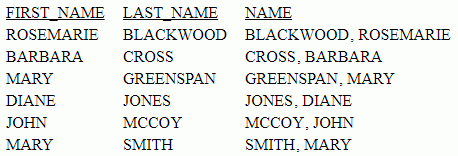
To produce the same output in a Unicode environment configured for code page 65001, replace the COMPUTE command for the field COMMA1 with the following syntax, in which the call to HEXBYT converts the integer value 14844058 to the comma character:
COMPUTE COMMA1/A1 = HEXBYT(14844058, COMMA1); NOPRINTExample: Converting a Decimal Integer to a Character
| WebFOCUS | |
|
Feedback |